Thursday, August 23, 2012

Teacher Training @ MDFT

Learning to build and pace effective units and lessons
Using everyday materials in our daily lesson plans for our baby class students to strengthen their pre-writing muscles
Creating an environment that stimulates discovery using really inexpensive manipulatives
A simple object like a cloth pg can become a science tool, a counting helper, a building tool and many more creative things 
With a little stored power, we are able to demystify technology even when we do not have electricity in our school.
For the last couple of months, the teachers at MDFT have been hard at work training and bringing the Flood Garden learning model to life.  It been such and exciting yet difficult process!! However, we have all really grown through the process of examining our teaching philosophy and blending it with brand new skills.
We make a very good team and we are trying to build a productive learning communities with the teachers from neighboring schools.  

Already many local teachers and school administrators have dropped by and asked us many questions about  what we do. As part of our training, we visited area schools to observe other educators in action, look for new ideas and recruit teachers to our learning community.  Many of the teachers that we talked to are very interested in participating in a 'new concept' such as a teachers group where they can share ideas, learning materials and resources (face-to-face and online!)

The teachers began their training attending online (via Skype.com) workshops twice to three times a week.  It was quite a challenge because in Arusha, there are all manner of obstacles that prevent or delay the most determined person from getting to where they need to get on time.  In this case, the teachers met at an internet cafe (which they had never used before) to access learning materials, videos and to participate in live workshops.

Even though they were not very convinced at first and were hesitant to embrace technology, they soon began to participate eagerly in our Flood Garden Teacher's Facebook learning group and our growing Flood Garden Google doc education goody bag.  We agreed that this was a great way to conduct professional development because we are using each other, the internet, our school garden, local colleagues and professional as well as the whole town of Arusha as professional development resources.

We hope that soon, we will be able to access via internet, educators from all over the world and share global learning communities!

Monday, August 13, 2012

New Learning Tools!!!!

Some of our awesome school materials

Every good teacher gets super excited to get new school materials and today we went to the local market to purchase some of our Flood Garden learning tools.  We use everyday tools to teach the children to teach them life skills.  We got some traditional trays, and many materials that will help develop pre-writing muscles and encourage the children to care for their environment, the garden and also their communities.  Our teachers have great plans to use these materials and they are so very excited for the beginning of term in September when they can really try this out.
This week, we have inviting a small group of children to come during the school break so that we can test some of our new lessons.  We are very thankful and very excited and cannot wait to tell you about our progress.
Thank you for following our story...let us know that you are there by commenting on our posts.

Tuesday, July 24, 2012

Help from the Least of Us..

This week, we had a visit from Babu Briton (Grandfather of Briton). He is the grandfather of two of our students, Briton (6 years old) and Vavai (4 years old). He has recently become unemployed and with is extra time he stopped by to see if he could help teach the children about flowers!


This is extraordinary that he would come to us to offer help rather than the other way around....


Babu Briton, Briton and Vavai (both in stripes)
Briton and Vavai come from a very poor family. They were abandoned by their father shortly after their mother, who was born with correctable but un-addressed birth defects, began to exhibit mental problems. She soon began to neglect her boys and her father Babu Briton, stepped in to help in their care. At that time, Babu Briton earned a living by clearing up brush from construction sites. However, recently, a thorn from a local bush damaged his eye. He couldn't afford immediate medical treatment so he lost the use of the eye and was no longer useful to his employers.


Babu Briton came to us this week because he really loves our school. He offered to share his knowledge of local plants and flowers in exchange for the tuition for his grandsons who have now been left in his sole care.


The boys were part of the first group of children that enrolled in our school 2 years ago. They both exhibited severe symptoms of neglect. At first Briton (then 4 years old), especially, had terrible behavioral problems, did not listen to his teachers and often fought with his classmates.


Since they started attending MDFT, they are both well fed, exhibit great hygiene practices and love to learn. Briton is now more himself and has become very reliable, responsible and a leader among his peers. In fact, Briton and Vavai received the first exercise books that were purchased with the profits of our first Flood Garden harvest.


Preventable and/or correctable health issues are left unchecked in most of our community. The children suffer a double tragedy, one is to not have access to needed resources and another is to lose their loved ones to such preventable issues.

Government Exam Time!


This week is Government Examination Week.  It is very important for the children to be at our school to take the exams and the parents must try very hard to get the kids to school on these days.
In Tanzania, children who do not take these exams cannot pass to the next level. Children who are too poor to attend preschool will stay behind academically until they are 9 years old and can enter the public school system.  In public school, many of these kids are often excluded from school offerings because there are no programs to help them catch up.  These students usually drop out of school.

This is also an important week for the Flood Garden Project.  The test results that we will collect this week will be the last academic records using the MDFT traditional school model.  The test results that will be collected on July 2013 should indicate the real academic impact of the Flood Garden Project learning model. We will be working hard this year and look toward that small but meaningful milestone.

Tuesday, July 17, 2012

The Flood Mamas

Recently, a group of mothers, locally known as mamas, gathered at our school.  Together with our school head master David, they started a small farm group to see if they too could create Flood Gardens near their homes. David talked to them about how to start their own little farming project and distributed seeds from the MDFT Flood Garden. These mamas are mostly AIDS widows or abandoned single mothers.
Flood Mamas' Farm plots before they planted


The mamas chose a leader among themselves and began to clear out a vacant common garbage lot.  Each mama now has a small plot in which to farm and most of them do their farm work in the morning so that they can take their harvested vegetables to the market for the day.


First mchicha crop
We now have a group of 18 mamas that have joined our Flood Mamas' group. They are an amazing group of young women that have now found a way to supplement their meager income by farming in a Flood Farm.  We would like to share their story.
Mama Ali selling her first harvest

Mama Ali (the mother of Ali, her eldest son) is the Flood Mama group leader.   She is a single parent of 4 young children.  2 of the children belong to her sister who pasted away from AIDS two years ago.  Until now, she has really struggled to feed the children in her care because she had no source of constant income. She and her children were abandoned by her husband.

Mama Ali now has a farm plot where she plants mostly mchicha, TZ spinach (amaranth) and a few other local vegetables. To date, with each weekly harvest, she is averaging about $22 per week.  This might be a small some to some but in her world this amount of money brings incredible improvement to her life.  Here is a short list of some of the things she can now afford:

  • She is now able to rent a small but clean room for her young family -- $5 per month 
  • She can buy up to 10Kg of maize flour every week -- $6 per week
  • She can buy salt --$1
  • She now has a bit of money to save and use for the children
Ugali and mchicha stew

Maize, water and salt are the ingredients used to make ugali, the traditional TZ staple.  Ugali usually served hot and works as a balanced side dish to a rich meat sauce but most people like Mama Ali can only afford to server the ugali alone. Many children live by eating only 1 or 2 small lumps of ugali per day.
Flood Mama working in her plot


Now, however, Mama Ali can afford to make ugali as a side to a more nutritious vegetable stew made with the products of her very own farm plot. With a bit of luck and hard work, Mama Ali and the Flood Mamas will be able to afford to make vegetable stew with beef broth and add needed proteins to their diets.


Sunday, June 17, 2012

Flooding Our Community

Latifah and Lilian
Latifah and Lilian's mother came by our Flood Garden (MDFT Preschool) several months ago where she was given green pepper seeds and a few pointers on how to grow them herself, in her own home.  Today, her family celebrates the harvest of their very first crop of shiny, delicious green pepper.  Soon, they will be able to supplement their income as well as their diets by selling these peppers.

This event and this picture truly highlight the spirit of New World Flood. These two gorgeous girls are learning to be the solution Africa is waiting for. They are now part of the Flood and will do their part by giving the pepper seeds away to others.

There are now 8 Arusha homes that have benefited from the seeds from our little farm and we will be bringing you all their stories.

We want to extend our profound Thank You
to everyone who is following our story
and to everyone who is lending their support.
Please consider becoming a part of 

One Single Drop is the Beginning of the Flood


Wednesday, June 13, 2012

Tuition Drive

One of the lessons that we have learned is that our little farm is currently too immature to produce enough vegetables to begin providing financial support to our school.  It will probably take a year or two for us to see a real surplus.  Although, we are really amazed about the positive impact our Flood Garden has had on our school and the community, we understand that we need to do more work and make it even better.

We have decided to ask for your help to get us through the next year or so while our farm is maturing.  We are starting a tuition drive so that our children can continue to attend our school for free. Many of our little ones are orphans and/or live with grand parents, and without our preschool they would be poorly supervised or even on the streets while their caretakers work to make ends meet.  Life on the streets of Arusha is very dangerous for unsupervised preschoolers.


One Single Drop is the Beginning of the Flood

Here is how you can help:

Sponsor a preschooler attending MDFT.  Tuition is $240 ($20 a month)


  • This donation will cover school fees, 2 nutritious meals a day and school supplies for one child for a whole year
  • An additional $100 per year will provide doctor visits and medicines
    • You will receive,
      • the child's progress report,
      • pictures and videos,
      • our school newsletter
      • printable art made by the student(s)
      • season's greetings from your student(s)
 Drinking coffee at a coffee shop a couple of days a week adds up to about $20 per month.  It is an small amount to the average coffee drinker but it is an amount that will give a little preschooler a great head start!!

We have 100 students so if possible, feel free to sponsor more than just one

Become a friend of the Flood Garden Project

Gift a monthly payments of $25, $50, $100, $200, $300, $400, $500, $600, $700, $800, $1000, or $5000+
Friends of the Flood Garden Project contribute a monthly amount to develop and spread Flood Gardens and the Flood Garden learning model into other Arusha schools.

We currently need monthly support to:
  • Create and build culturally appropriate learning materials and tools for the preschool
  • Provide field trips for the students
  • Provide steady Professional Development for the Flood Garden teachers and staff
  • Promote the Flood Garden Project
  • Provide community outreach events to spread the Flood through out our Arusha community
  • Expand the Making a Difference Foundation Tanzania school from an amazing preschool to a wonder and effect primary and secondary program
  • Expand the Flood Garden Project from a school garden into a viable and profitable farm to achieve our goal of making the Making a Difference Foundation Tanzania school(s) totally self-sufficient

You can also help us shorten our WISH LIST.  Here are some items that we could really use:

  • Bookshelves -- we currently need about 8-10 small bookshelves to place learning materials at a level where the children can easily reach them.  Currently, our classrooms have NO shelves.
          • Each shelf costs about $30 (50,000Tsh)
          • Total cost of 10 shelves $300
Note: Purchase a shelf and we will display your name or the name of your business/organization in a prominent place on that shelf

and our 'donate' button is not yet online 

If you are interested in helping us, please contact:
matingaragatz@newworldflood.org
or 
heathersheets@newworldflood.org

YOUR DONATION IS TAX DEDUCTIBLE

Monday, April 9, 2012

Turning Rubbish into Gold

MDFT kidlets tossing collected garden refuse into the compost pit.

Composting and Me

Teach Young Children How to Value Themselves

Composting is the oldest form of recycling.  It provides an opportunity for our little ones to observe the
decomposition process and energy cycle at work.  It will also produce a valuable soil supplement for our garden and it reduces the amount of organic trash in our neighborhood

The students will  learn how the many soil organisms recycle organic wastes through composting. They will also have a chance to observe first hand how the soil organisms in small compost samples decompose into a very valuable resource by the end of the school year.

Children in our neighborhood are not often taught to value themselves.  As they grow older, they soon learn to value the plastic western cultural stereotypes that they see on television, music videos and hear over the radio air waves. This is a twisted view of life that currently allows for the cultural acceptance of very strange cultural norms.  For example, foreigners working in Tanzania often earn substantially more income than the locals doing the same job.  

It is a matter of self value!

Through a lesson in Composting, our young students can learn about the important academic concepts regarding the optional disposal of organic refuse.  But most importantly, they can also learn a very important social lesson about themselves as individuals and their role in their own community.  The take away life skill that we want to teach here is that young children like themselves, no matter how poor, how invisible, how small or how weak, can work to play a major part in a community.  We want to emphasize that they all have an important role to play and only through playing their part will they see results in the long run.  

This is also a wonderful lesson for the teachers at MDFT.  By deconstructing the traditional way of teaching children, we are able to observe the preschoolers learning cycles at work.  

There is a process and a cycle at work in their young lives too. This is a fundamental lesson that we hope to build on as we teach academics and social skills through gardening, community service and tons, and tons of fun!!!

Please feel free to comment and leave us ideas for cool and fun things we can learn in the Flood Garden!

Tuesday, March 13, 2012

Students Learn Better Outdoors!!!

Head Master David Gido conducting an impromptu lesson in the new outdoor classroom
We recently added a proper outdoor classroom in the Flood Garden.  The outdoor classroom will not only serve as a wonderful place to learn but will also create extra classroom space.  We added a used whiteboard and parallel siting space for the children to share their learning in the garden.  Also, with the addition of floor mats, the can transform any empty outdoor space into a classroom.

Many studies show that children learn better outside. According to the National Wildlife Federation learning outdoors has a great impact on student's academic performance.  According to a 2010 report, learning outdoors among many things,

  •  improves classroom behavior,
  • increases student motivation and enthusiasm to learn
  • improve performance in math, science, reading and social studies
  • reduces Attention Deficit Hyperactivity Disorder (ADHD)
  • increases scores in standardized tests
  • helps under-resourced, low income students perform measurably better in school

 We are anxious to begin taking advantage of the outdoor classroom as a resource and see how it improves our student's learning.  We will keep you posted and show you along the way, how we use this space in our lesson and what our students think about it as well.

The Flood Garden will offer many opportunities for projects, challenges and hands on learning for our students, teachers and parents.  We appreciate any ideas and suggestions from those of you who are already using outdoor spaces to teach young children.

Understanding the challenges of teaching and learning outdoors.

Monday, February 27, 2012

Lessons in the Garden

Our garden is now ready for formal lessons with our students.  In the coming months, the teachers at MDFT will be spending a lot of time transforming their traditional classroom lessons into Project/Challenged Based Learning lessons.
We will not only create the lessons but we plan to write the books that we might need and also build all the learning materials.

This is a very ambitious project but with the end of the school term coming soon.  The teachers will have time to prototype some lessons but then spend the months of April and May learning new teaching methods as well as understanding the freedoms and possibilities of creating ones own customized classroom tools


One of the themes that we hope to develop and study next term is that of collaboration and team work.  Children that grow up in poor or needy communities learn quickly to fend for themselves.  Many times, the actions of providing for one's survival become increasingly self-centered and leave very little room for kids to think about actions that benefit their environments, their neighborhoods and communities as a whole.

Actions like throwing trash in the streets and not bothering with creating a beautiful space for themselves are common scenes in the environment our children come from.  People rarely work to benefit the group but are often focused in themselves and their immediate families.

We hope that our students begin to understand the power of working collectively and for a common good.   By first teaching them about the importance of their own roles in the Flood Garden, we hope that they will understand how each child's role is important to the group and to the goal.

students visiting the rabbit house s
  
The clean up crew making sure our gardens are clean and beautiful
MDFT's students are an important part of the future of Tanzania.  During their time with us, we hope to give them the tools they will need to improve their lives in the future.


Friday, February 24, 2012

In the Flood Garden on Inauguration Day

This was a very special day indeed.  Not only was it a wonderful way to show our community how beautiful our Flood Garden has become but it was also Uncle TJ's birthday.  So we celebrated with songs, speeches, great food and a wonderful tour of the Flood Gardens.

THE GREAT REVEAL!! Head Master David Gido was very proud to reveal the Flood Garden to today's visitors

Our duck house is painted and all ready to house our new tenants. The fish pond looks great and soon the plants we planted around it  will really make it look like a real pond.  We need to fence the animal areas before we can move in the ducks and the tilapia 

WE HAVE RABBITS NOW!! They have become very fat and soon we hope to have babies and learn all sorts of lessons from them.  We also have Guinea Pigs and one of them has had babies.  We will devote more posts on just our animals as they become part of the classroom lessons.

This is one of our rabbits behind their little chicken wire doors.  The rabbits do not have names yet.  Maybe we will have a contest with the children to see what names win!!

Auntie Robyn loved the rabbits

The Maasai house will not only allow us to study Tanzanian history and culture but also makes a very handsome kitchen!  I especially like the Maasai warrior drawings on the walls of the house and the painted tires!

Salum, a garden volunteer and friends of David, David himself, Uncle TJ and Mr. Mwasaga, MDFT's new advocate

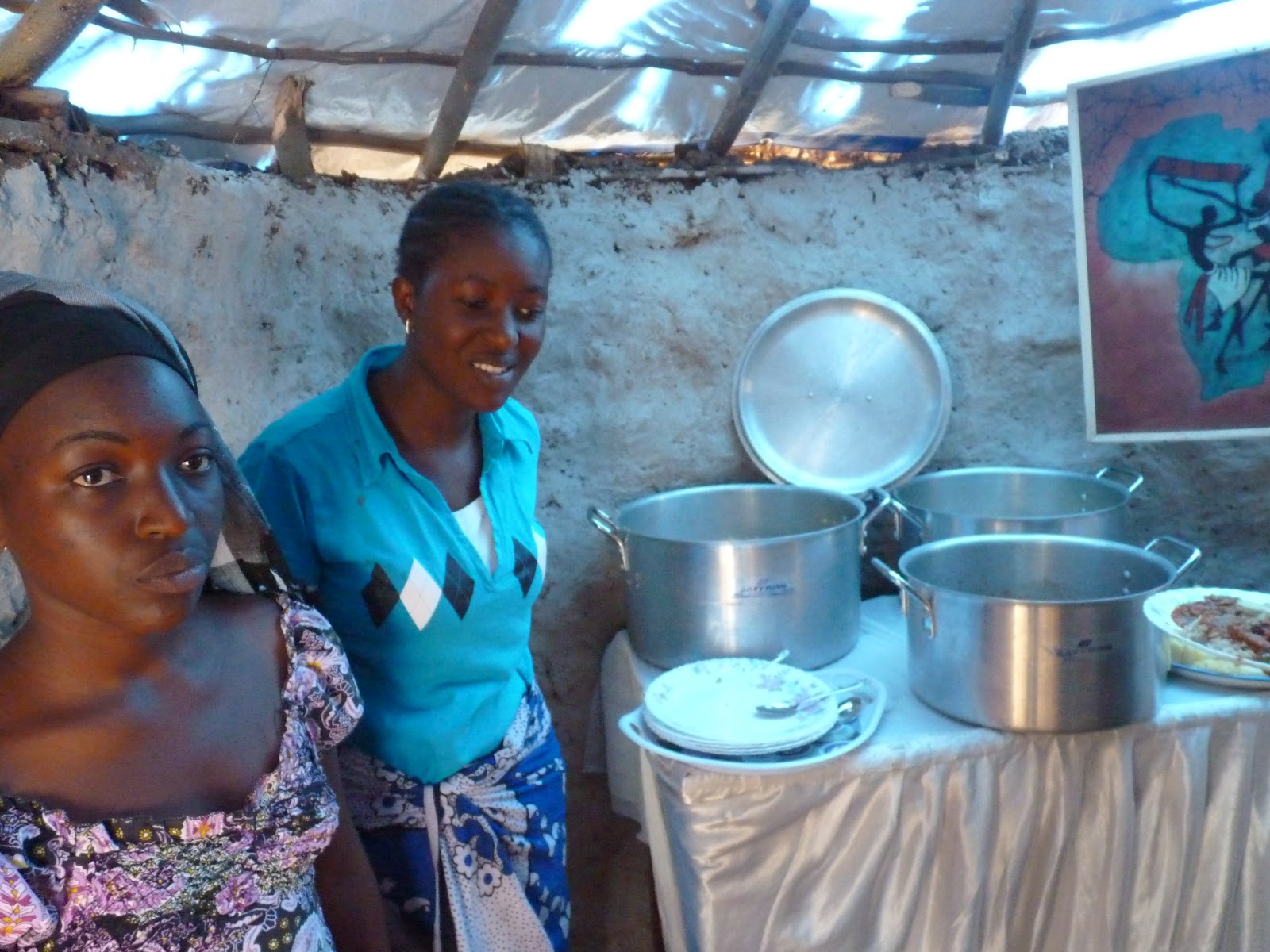
Inside our Maasai House Kitchen.  It is very spacious and unbelievably sturdy.  It is also provides an unexpected shelter from the intense Tanzanian heat.  Many, many meals will be cooked here from now on.

With just a few bed sheets and blue tarps, David Gido and the MDFT teachers transformed this once garbage dumb into a wonderful banquet space.  It looks good enough for a wedding reception!!

Flowers are always beautiful and today they added a wonderful elegance for our inauguration banquet

Our greens are looking great considering how hot and dry it is during the Tanzanian dry season.  In fact, our flat leaf veggies are the only ones thriving in the intense heat.  We have learned an important lesson in seasonal planting, even when we think it is not too hot for humans!


Mr Mwasaga and TJ were kind enough to speak to the group on this important day.  Mr. Mwasaga is a member of our community who has come to our aid and advocates for MDFT whenever petty local officials come around looking for excuses to fine the school. He told us how important the Flood Garden has become for community and how it is important to invest in the youth.  Mr. Mwasaga is a retired park ranger and use to work in the Safari tourism scene.  He is very familiar with the written and unwritten Tanzanian history and geography and hearing him speak really reminds us of the importance of the elder generation in the lives of our children.  We hope to use his wisdom and guidance in our attempts to recreate traditional culture for our kids.

TJ travels from school to school in the state of Michigan challenging students to play their part and pick up the slack in the economy through service and volunteering.  Today he challenged everyone in the audience to consider their roles in the growth of the children at MDFT. he reminded everyone that each one of us is like a drop of rain, we have a purpose and thus must fulfill that purpose.  By ourselves we fulfill a purpose but together we can start a flood.

We would like nothing else than to flood Arusha with Flood Garden schools.  Since December, when the first seeds were planted in the ground, we have already witnessed the change in our students, the growth in our teachers and a sense of wonder and hope in our community.  People stop by just to hang out and many have a lot of questions.  Soon, we hope to plant flowers, fruits and veggies throughout our neighborhood.  In a few years, we hope that our entire village looks like our flood garden; a busy but clean urban environment with tranquil, beautiful and bountiful garden spaces.
  

In the kitchen getting food

February 17th, A Very Joyful Day

Here are some highlights of this special day:


The wonder in our child lost in song makes us understand how important it is to preserve their sense of discovery.  

Uncle TJ showed the children videos of themselves on his iPad!  They went NUTS!! These children seldom , if ever, see themselves on film or photos so this was a real treat.

We are no where near being able to afford technologies such as interactive tablets but watching the children watch themselves on the iPad was truly amazing.  We currently cannot afford electricity for the school so this dream will have to wait a while.
Uncle Rich recorded video of the children too!

Auntie Joyce also showed the children the wonders of her interactive tablet.  Just look at them!!!
Auntie Joyce and Auntie Robyn signing our guest book during their visit

A Very Special Day!!

Uncle TJ came to spend his birthday with us at MDFT today !! He is our favorite uncle, the founder of New World Flood and the inspiration behind the name of our garden "Flood Garden".  Uncle TJ is a former American Football star and the supporters of many social causes in the USA and so it it an honor and an inspiration every time he comes.
Uncle TJ brought us lots of sweets!!!

He is our biggest fan and a great supporter of MDFT
He came with lots a sweets and a simple message:  Everyone is a drop of rain and it only takes one drop of rain to begin a flood.
At MDFT, we will be raising children who understand Uncle TJ's philosophy about playing one's role in life. The children at MDFT have a big role to play in the future transformation of Tanzania.


First the children sang welcome songs led by teacher Jackie, teacher Agnes and teacher Nixon.  Then after our guests signed our guest book, they were treated to classroom demonstrations in the baby class (our Seeds), the middle class (our Sprouts) and older class (our New Stems).  They were great!! They more songs and had a blast playing with Uncle TJ's videos on his iPad.
the older children singing welcome songs!!

Then Uncle TJ and his team were taken to see our Flood Garden. We are very very proud of our garden.  David Gido, the head master and his wonderful team of teachers and helpers covered the garden so that we could have a GREAT REVEAL!!.  Everyone was shocked and touched at how beautiful our garden looks.  It is pretty enough to perform weddings in!!!

The Flood Garden wrapped up in bed sheets and ready for the big REVEAL!!!

The MDFT staff served a wonderful buffet of rice and traditional beef stew accompanied by vegetables from the garden and fruits.  The food was delicious!!

Inside our Maasai house  kitchen, the helpers served a wonderful meal
The cucumbers were grown in our Flood Garden and went well with the other fruits and veggies

What a great innauguration day Feb. 17th turned out to be!!